

A step-by-step guide for new independent P&C agency owners
How to Start an Independent Insurance Agency From Scratch

What are the steps to start an independent insurance agency from scratch?
- Get licensed. Complete your state’s pre-licensing education, pass the state P&C exam, and apply through your state department of insurance. Here is a harsh reality: you should have experience before starting an agency. If you don’t have at least 6 months of experience prospecting, quoting, closing, and servicing, we’d encourage you to shadow a mentor or work as a producer before jumping right in to start your agency.
- Develop a business plan. Define:
- Your target customers
- Budgets: how much will you allocate to ad spend, referral fees, business cards, phone line, email, website, etc.
- How will you get in front of prospects each month.
- How much commission you need to earn to pay your bills
- Production goals to make sure you’re on track to hit your revenue and income goals
- How much of your business will be personal lines, and how much will be commercial.
- How many employees will you have, and when?
- What state(s) will you advertise in?
- Why would referral partners want to work for you?
- Form the business.
- Set up a legal entity
- Get an EIN
- Open a business bank account
- Have a place to track expenses and income
- Get your entity licensed so it can legally receive commissions.
- Buy E&O insurance. Most carriers will not review an agency application without proof of E&O coverage.
- Set up technology. A new agency needs an AMS and ideally a comparative rater at minimum.
- Get carrier appointments. Apply to carriers directly, join an agency network, or use both.
- Build a prospecting plan. Line up referral sources and lead channels before your first carrier appointment is active.
- Stay compliant. Follow carrier guidelines, and maintain your continuing education to keep your license active.
How do you get licensed and set up the business?
- State licensing: most states require pre-licensing education, a state exam, fingerprinting and a background check, and a resident producer license application.
- Additional states: selling outside your resident state requires a non-resident license in each state, for both the agency principle, and for the entity.
- Business entity: most new owners form an LLC or corporation, get an EIN, and open a business bank account. Some start as an LLC and consider an S corporation election once the agency is consistently profitable, so ask a CPA who works with agencies when that makes sense.
- Agency licensing: if you operate through a business entity, expect a business entity license or registration as well. Published estimates as of October 2026 put licensing at roughly $120 to $349 per person and entity registration at $100 to $500.
What insurance and technology does a new agency need?
- E&O insurance: published estimates as of October 2026 range from about $500 to $5,000 a year for a new agency. Your price depends on your lines of business, your state, and your expected revenue.
- Agency management system: published subscription estimates start around $60 to $500 or more per month. Examples include EZLynx, Hawksoft, Momentum, Applied, and others.
- Comparative rater: a comparative rater lets you quote several carriers from one set of customer information, so it directly affects how fast you can quote.
- CRM or follow-up tool: Many AMS platforms include one. If yours does not, you need a way to log prospects, schedule follow-ups, track emails and phone calls, help with retention efforts, and help your agency to run smoothly.
- Phone system: VOIP is increasingly popular, like RingCentral, Dialpad, Ooma, or Vonage. But any dedicated phone line will do.
- Website: A place where clients can learn about you, your agency, and start quote and service requests. A website also helps with your Google Profile, and discoverability.
Build this in layers. One industry guide advises starting with the AMS and rater and adding other tools only after you have defined your workflows. Published monthly technology budgets range from about $360 to $2,000, depending on how many tools you add.
How do you get carrier appointments as a new independent agency?
Appointments typically take 2 to 6 weeks through an agency network, and 1 to 6 months if you get appointed on your own. Carrier review and underwriting is usually the longest stage, and each carrier sets its own timeline.
Have these ready before you apply:
- An active state license.
- Proof of E&O coverage.
- Business entity documents.
- A business plan with realistic production estimates, because carriers want to see how you plan to grow.
Carriers set their own requirements. Some want a minimum book of business. Others want several years of experience in the industry, which is why many scratch agencies find appointments difficult to get on their own. Carriers also check whether your territory is already saturated, and a “yes” on any background question can trigger a manual review that adds weeks or months.
Established agencies are appointed with 17 carriers on average, according to the 2024 Big “I” Agency Universe Study, but a new agency will usually struggle to keep that many carriers satisfied with production requirements.
If you’re not using a network to get appointed, it’s possible that two to three strong carriers per niche is often enough to get off the ground. Add carriers one at a time, and only when you can meet each carrier’s volume expectations, because losing an appointment can be hard to reverse.
If you are considering a network, ask these questions and get the answers in writing before you sign:
- Fees: what are the upfront, monthly, and any other fees?
- Contract: how long is the contract, and what does it cost to leave?
- Book ownership: who owns the book of business, and can you transfer it if you leave?
- Carrier access: which carriers will you have binding authority with, and which are reached through another platform or broker?
- Commission: what split applies to new business and renewals, on direct and brokered carriers?
- Production: is there a production requirement, overall or per carrier?
- Profit sharing: does the network pay profit sharing or contingencies, and on which carriers?
| Category | Direct appointment | Network, cluster, or aggregator |
|---|---|---|
| How access works | You contract with each carrier yourself. | The network already holds carrier contracts, and you access them through its agreement. |
| Commission | Often lower to start since you have no negotiated commission. As you grow, you can negotiate higher commissions. | Varies by network and carrier. Ask for the split on each carrier, and see if you can make more by getting increased compensation, even if there is a split attached. |
| Production requirements | Set by each carrier, and may include annual requirements, an existing book, or to be in the top 3 of your agency. | May be lower for members. Confirm the requirement for each network. |
| Speed for a new agency | Typically 1 to 6 months, and harder to get as a new agency. | Typically 2 to 6 weeks, with access to several carriers at once. |
| Fees | Carrier fees vary. Confirm them with each carrier. | Membership usually involves fees. Confirm upfront, monthly, and exit fees. |
| Contract terms | A separate performance contract with each carrier. Losing one can be hard to reverse. | One agreement with the network. Length and exit terms vary, so read them before signing. |
| Book ownership | Governed by each carrier contract, so check expiration ownership. | Varies. Confirm who owns your book and whether you can transfer it. |
What does it cost to start an independent insurance agency?
These ranges come from guides published by vendors that serve new agencies, so they are estimates, not independent benchmarks. Use them as a starting point and get your own quotes.
- Lean, home-based, solo owner: about $5,000 to $15,000.
- Small office with one support staff member: about $15,000 to $30,000.
- Full-service launch: $50,000 to $100,000 or more. Another vendor guide puts the range for an independent agency at $20,000 to $175,000.
The totals break down into these line items:
- Licensing: about $300 to $1,500 per person, depending on pre-licensing courses, exam fees, and fingerprinting.
- Business registration and legal: about $500 to $2,500 in the first year.
- E&O insurance: about $500 to $5,000 a year.
- Technology: about $360 to $2,000 a month.
- Marketing: from $0 to $5,000 a month.
- Office: under $1,000 in equipment for a home office, and potentially $20,000+ to furnish an office, then you have the lease on top of it.
Staff is the largest optional cost. Most new owners avoid hiring until commission income can pay for it.
How much savings do you need before starting an independent agency?
Savings matter because commission income starts slowly. Commissions typically take 30 to 45 days to start flowing after a policy is written, and your renewal base grows only as you write more business. You also spend on the start up costs and marketing before the first commission arrives.
To size your cushion, add these four amounts:
- Personal living expenses for the months you want to cover, such as housing, utilities, insurance, food, and debt payments.
- One-time startup costs, including licensing, entity filing, E&O, equipment, and any network or software setup fees.
- Monthly business costs for the same months, including technology and marketing.
- A buffer for slower months and unexpected costs.
Here is an illustrative example, with made-up numbers you should replace with your own. An owner with $5,000 in monthly living expenses, $10,000 in one-time startup costs, and $1,500 in monthly business costs would need $30,000 for six months of living expenses ($5,000 x 6), plus $10,000 for startup, plus $9,000 for six months of business costs ($1,500 x 6). That totals $49,000 before any buffer.
A second household income can drastically help an agency more comfortably get through the launch phase.
How do you get your first customers and a steady flow of prospects?
How quickly you write your first policy after your appointment is active depends mostly on your marketing plan. In Firefly’s experience, it can happen the same day or take a couple of weeks. Owners who line up prospects before their appointments are active tend to start sooner.
- Start with the people you know. Friends, family, former customers where your agreements allow, and community contacts often refer you or become your first customers. Tell them what you write and who you can help.
- Build referral partnerships. Real estate agents, mortgage brokers, and similar professionals meet people at the moment they need coverage. Agree on how you will respond quickly to each referral.
- Add channels you can measure. A Google Business Profile with customer reviews, a mobile-friendly website, and organic social media is measurable, and usually inexpensive.
- Paid leads or online ads can add volume, and cost more. Paid channels cost money for every prospect, so set a monthly budget and track the cost of each policy written.
- Track and follow up. Set a weekly quoting target, log every prospect in a CRM or your AMS, and follow up on a set schedule.
- Ask each new customer for a referral and an online review.
What do the first two years of a new independent agency typically look like?
This worked example uses that range. Writing $30,000 to $50,000 a month adds up to the following cumulative premium, before any policies are lost at renewal:
- After 6 months, an agency writing $30,000 to $50,000 a month has written $180,000 to $300,000 in premium.
- After 12 months, the same agency has written $360,000 to $600,000.
- After 24 months, the same agency has written $720,000 to $1,200,000.
Your commission depends on your carriers and lines. Across all P&C lines, independent agencies averaged an 11.5% commission in 2024, according to the Big “I” Market Share Report, with private passenger auto among the lowest at 8%.
At 11.5%, 12 months of new premium at this pace would produce roughly $41,400 to $69,000 in commission on that premium, before renewals.
To estimate your own income, you can use Firefly’s calculator at www.fireflyagency.com/calculator.
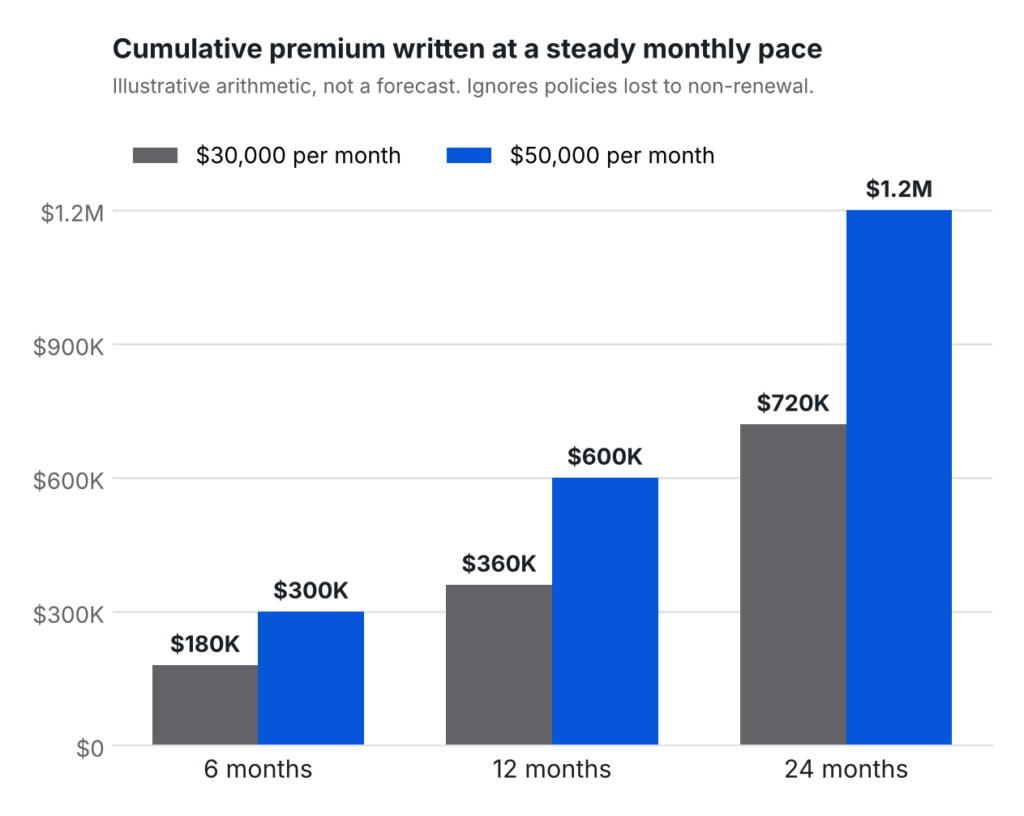
Cumulative premium written at a steady monthly pace. At $30,000 a month it reaches $180,000 after 6 months, $360,000 after 12, and $720,000 after 24. At $50,000 a month it reaches $300,000, $600,000, and $1.2 million. This is illustrative arithmetic, not a forecast, and it ignores policies lost at renewal.
Source: Calculated from the $30,000 to $50,000 monthly premium range typical of an average agent with no staff, in Firefly Agency's experience with new agencies
What mistakes do new independent agencies make?
- Writing business outside your expertise. In Firefly’s experience, an owner building a personal lines agency will often start writing random commercial prospects who walk in, even though they do not know commercial insurance and are not pursuing it. This can lead to coverage gaps, E&O exposure, and wasted time. Refer those prospects out or build commercial expertise on purpose.
- Adding side income before the core business works. Some new owners take a part-time job or add services such as tax preparation or financial planning before their insurance book is running smoothly. Splitting your time early slows the prospecting that builds your book.
- Adding carriers faster than you can support them. Industry sources advise adding carriers one at a time, only when you can meet each carrier’s volume expectations, because losing an appointment can be hard to reverse.
- Signing a network or carrier agreement without reading the exit terms. Contract length, exit fees, and who owns your book of business all vary, so check them before you sign.
- Starting without enough cash. Running out of savings before commissions build forces many owners back to full-time work, so size your cushion before you start.
Is starting an independent insurance agency from scratch right for you?
It is a good fit if you already know how to quote, sell, and service personal or commercial lines, you hold a resident P&C license or can finish licensing before applying to carriers, and you have at least six months of living expenses saved or another household income. You also need to be willing to prospect and follow up every week, because a scratch agency has no company-provided leads.
A different path may suit you better if you need a guaranteed salary and company-provided leads, in which case working for an established agency may be a better fit. It may also suit you better if you have no insurance experience, because working at an agency first teaches the product and the customers before you carry E&O risk and startup costs. Buying or joining an existing book of business is a separate path from starting from scratch. A plan to start a part-time job or second business first can also slow the prospecting that builds a book.
Is starting a scratch agency a fit?
Good fit
- An experienced P&C producer or CSR who already knows how to quote, sell, and service personal or commercial lines.
- A person who holds a resident P&C license or can finish licensing before applying to carriers.
- An owner with at least six months of living expenses saved, or another household income that covers personal bills.
- Someone willing to prospect and follow up every week without company-provided leads.
Better fit elsewhere
- A producer who needs a guaranteed salary and company-provided leads, who may do better working for an established agency.
- A person with no insurance experience, who needs to learn more by working at an agency before taking on E&O risk and startup costs.
- An owner who wants to buy or join an existing book of business, which is a different path from starting from scratch.
- Someone who plans to start a part-time job or second business first, because splitting time slows the prospecting that builds a book.
Run your own numbers before you start
Enter how much premium you expect to write and see what your income could look like.
OPEN THE CALCULATOR